|
|
| (4 intermediate revisions by 3 users not shown) |
| Line 2: |
Line 2: |
| __NOTOC__ | | __NOTOC__ |
|
| |
|
| [[File: ws.jpg | 850px ]] | | [[File: Group3_Model_foto.png | 850px ]] |
|
| |
|
| ---- | | ---- |
| | | |
| '''Group 3''': Caterina Lovo - Cyrill Haas - Domina Lučin - Juliette Zamani Alavijeh - Lisa Holbrook - Niklas Murmann | | '''Group 3''': Caterina Lovo - Cyrill Haas - Domina Lučin - Juliette Zamani Alavijeh - Lisa Holbrook - Niklas Murmann |
| ---- | | ---- |
|
| |
|
| Line 28: |
Line 28: |
|
| |
|
| <br> | | <br> |
| | == '''Project Overview''' == |
|
| |
|
| =='''Design'''==
| | This project explores adaptive lighting systems through computational design, geometry scripting, and prototyping. |
|
| |
|
| | The adaptive lighting system is based on parametric geometry and environmental responsiveness. |
| | Grasshopper was used to generate dynamic forms that react to spatial and lighting conditions. |
|
| |
|
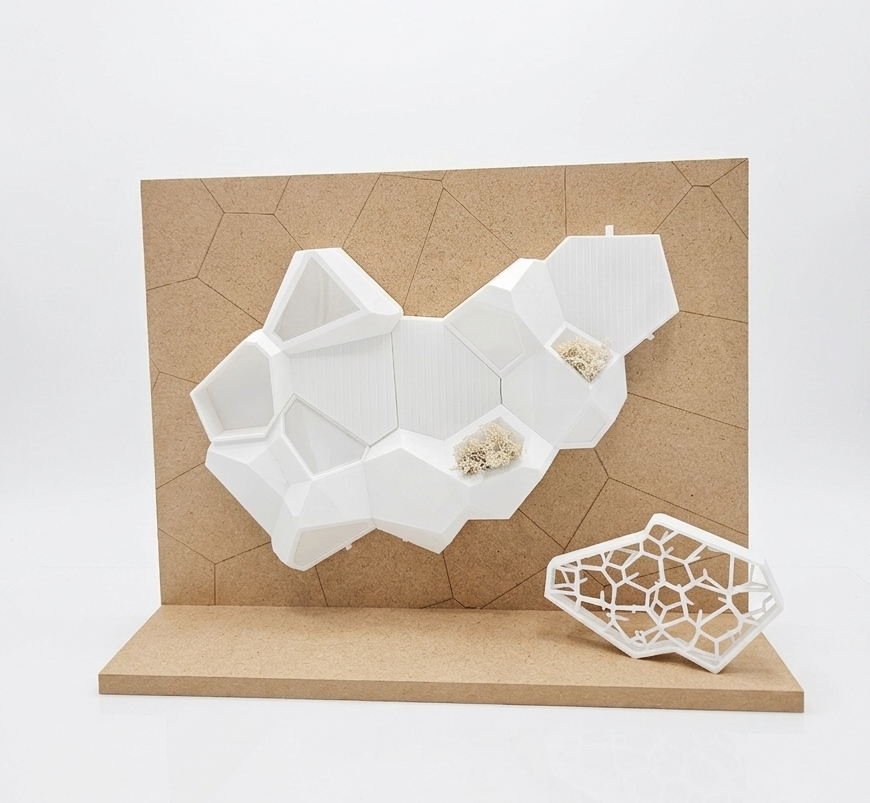
| [[File:Physical model prototype.png|thumb]]
| | The design development includes iterative modeling, testing, and refinement of geometry strategies. |
| | |
| | |
| "The Cave Pulse Light Experiment" investigates the limitations and potential of living within one or more container modules in remote scientific stations in Antarctica.
| |
| | |
| Inhabitants are facing long-term physical and psychological challenges associated with extreme arctic conditions, harsh environmental constraints, isolation, confinement and inadequate lighting.
| |
| The research seeks to understand how spatial configuration, environmental stimuli and interior design strategies can improve the daily routine of researchers.In particular, the study aims to design a habitable and reconfigurable cave-like stacked container interior where sleeping, working, exercising and social interaction can coexist within a limited spatial footprint, while simultaneously promoting physical health, mental wellbeing and overall comfort for its occupants.
| |
| | |
| Building on background research into Antarctica’s environment, Voronoi-based geometry and AI-assisted lighting design to robotic production and operations (D2RP&O) approach is emphasized. The study proceeded through a series of integrated design and development steps, including activity mapping, spatial concept formulation, parametric modelling in Grasshopper, integration of AI-assisted lighting, detailed fragment design, prototype and material selection, and fabrication planning using 3D printing strategies.
| |
| | |
| Project result demonstrates how an integrated, human-centred design strategy can transform extreme habitation into a supportive, engaging, and health-promoting environment, offering broader potential implications for future research stations and other extreme living contexts.
| |
Group 3: Caterina Lovo - Cyrill Haas - Domina Lučin - Juliette Zamani Alavijeh - Lisa Holbrook - Niklas Murmann
Project Overview
This project explores adaptive lighting systems through computational design, geometry scripting, and prototyping.
The adaptive lighting system is based on parametric geometry and environmental responsiveness.
Grasshopper was used to generate dynamic forms that react to spatial and lighting conditions.
The design development includes iterative modeling, testing, and refinement of geometry strategies.

